2025 CAIRFI Symposium: What's Next in AI and Finance
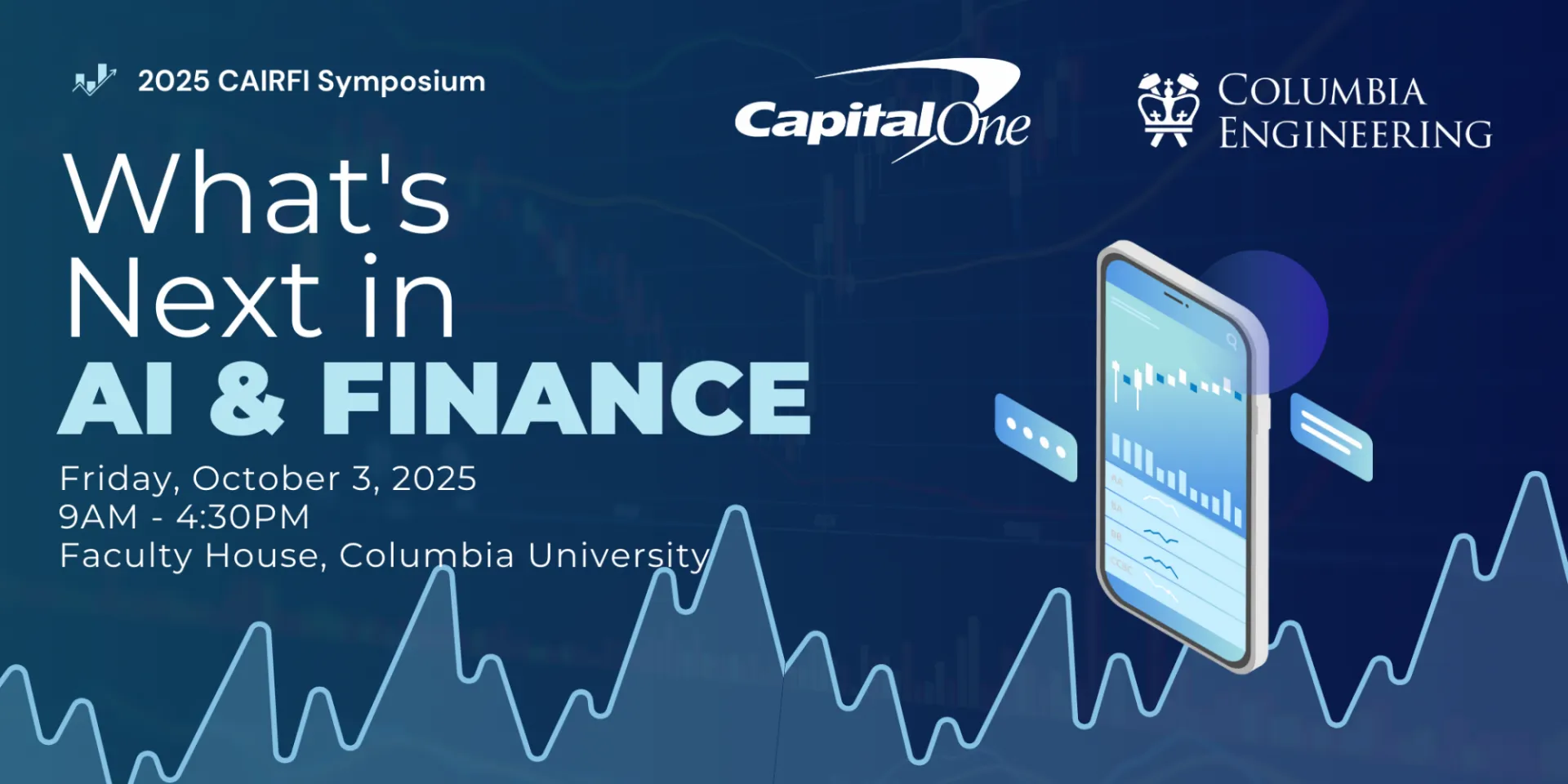
You are invited to participate in the Columbia Center of AI and Responsible Financial Innovation's 2025 Symposium on the Future of AI and Finance.
EVENT DETAILS
Schedule
- 9:00 | Registration & Breakfast
- 10:00 | Introductory Remarks
- Shih-Fu Chang, Director, CAIRFI; Dean, Columbia Engineering
- 10:10 | Keynote: Indistinguishability and the Crystal Ball
- Cynthia Dwork, Gordon McKay Professor of Computer Science, Harvard School of Engineering
- 10:50 | Session: AI, Privacy, & Security in Finance
- The Promise and Challenge of Differential Privacy | Rachel Cummings, Associate Professor of Industrial Engineering and Operations Research, Columbia Engineering
- Jailbreaks for Good: Automated, Effective Red-Teaming of AI Before It Breaks in the Wild | Junfeng Yang, Professor of Computer Science, Columbia Engineering
- Session Moderator: Stephen Rawls, Capital One
- 11:50 | Remarks
- Prem Natarajan, Chief Scientist & Head of Enterprise AI, Capital One
- 12:00 | Lunch & Poster Session
- Options Pricing using DINNs (Derivatives Informed Neural Networks) | Siddharth Karmarkar
- PersonaLedger: Generating Realistic Financial Transactions with Persona Condistioned LLMs and Rule Grounded Feedback | Dehao Yuan
- QuEst: Enhancing Estimates of Quantile-Based Distributional Measures Using Model Predictions | Ben Eyre and Amogh Inamdar
- DoubleAgents: Exploring Mechanisms of Building Trust with Proactive AI | Tao Long and Billy Zhang
- TabImpute: Accurate and Fast Zero-Shot Missing-Data Imputation with a Pre-Trained Transformer | Dwaipayan Saha, Jacob Fietelberg
- 1:30 | Session: AI and Causality
- Towards Causal Artificial Intelligence | Elias Bareinboim, Professor of Computer Science, Columbia Engineering
- Operational Dosage: The Impact of Capacity Constraints on the Design and Interpretation of Experiments | Hannah Li, Assistant Professor, Columbia Business School
- Session Moderator: Agostino Capponi, Columbia Engineering
- 2:30 | Talk: The Future of Consumer Credit
- AI Deployment Framework for Consumer Credit Models | Miao Wang, Industrial Engineering and Operations Research, Columbia Engineering
- Session Moderator: Ali Hirsa, Columbia Engineering
- 3:00 | Panel: Future of AI & Fintech
- Henry Yuen, Associate Professor of Computer Science, Columbia Engineering
- Atlas Wang, Associate Professor of Electrical and Computer Engineering, UT Austin
- Randall Balestriero, Assistant Professor of Computer Science, Brown University
- Panel Moderator: Bayan Bruss, Capital One
- 4:15 | Closing Remarks
Advance registration is required for both Columbia affiliates and non-affiliates. A virtual participation option is available.
Venue Join us on Columbia University's Morningside Campus in New York City. Campus map/directions/parking
ABOUT THE KEYNOTE
Indistinguishability and the Crystal Ball
Computational indistinguishability is a core concept in theoretical computer science. In cryptography we require that encryptions of messages x and y are indistinguishable by any feasible computation. In differential privacy we require that analyses carried out on similar datasets should be indistinguishable, thereby hiding the fine-grained details of the data. More recently, the lens of indistinguishability has been focused on predictors. In their simplest form, predictors assign a number, often interpreted as a probability, to individual instances: what is the chance that this individual will repay the loan? How likely is it that this student will graduate on time? But what is the probability of a non-repeatable event? In other words, what exactly are these algorithms supposed to be producing? This is a deep and unresolved problem in the theory of probability.
Outcome Indistinguishability frames learning not as loss minimization-–the dominant paradigm in supervised machine learning--but as satisfaction of a collection of indistinguishability constraints. Consider two alternate worlds of individual-outcome pairs: In the natural world, individuals’ outcomes are generated by Real-Life’s true distribution; in the simulated world, individuals’ outcomes are sampled according to a predictive model. Outcome Indistinguishability requires the learner to produce a predictor such that the two worlds are computationally indistinguishable. The notion has provided a generous springboard, first and foremost in machine learning, and also in complexity theory.
About Cynthia Dwork
Cynthia Dwork, Gordon McKay Professor of Computer Science at the John A. Paulson School of Engineering and Applied Sciences at Harvard, and Affiliated Faculty at the Harvard Law School and the Department of Statistics, is renowned for placing privacy-preserving data analysis on a mathematically rigorous foundation. A cornerstone of this work is Differential Privacy, a strong privacy guarantee permitting sophisticated data analysis. Differential Privacy is widely deployed in industry, including in every Apple device, and is the backbone of the Disclosure Avoidance System for the 2020 US Decennial Census.
Dwork joined Harvard after more than thirty years in industrial research at IBM and Microsoft. Some of her earliest work established the pillars on which every fault-tolerant distributed system has been built for decades.Her innovations modernized cryptography to cope with the ungoverned interactions of the internet through the development of non-malleable cryptography; provided a proof-of-concept for the post-quantum era with the first lattice-based public-key cryptosystem, which also was the first to enjoy worst-case/average-case equivalence; fought email spam and formed the basis of crypto-currencies through proofs of work; and gave the first general approach to ensuring statistical validity in exploratory data analysis, via a connection to differential privacy. In 2012 she launched the theoretical investigation of algorithmic fairness, a topic experiencing explosive growth and the driving force behind the multidisciplinary Hire Aspirations Institute devoted to fairness in hiring platforms.
Dwork is a member of the US National Academy of Sciences, the US National Academy of Engineering, and the American Philosophical Society, and a Fellow of the American Academy of Arts and Sciences and of the ACM. Her awards include the Gödel Prize, the ACM-IEEE Knuth Prize, the ACM Paris Kanellakis Theory and Practice Award, the RSA Mathematics Award, the IEEE Hamming Medal, and test-of-time recognition in four fields.
ABOUT CAIRFI
Columbia's Center for AI and Responsible Financial Innovation is a five-year partnership with Capital One that accelerates research, education, and the responsible advancement of state of the art AI in financial services.
Campus Access In accordance with the University's current visitor guidelines, all non-Columbia guests must be registered with Public Safety in order to access campus. If you do not have a CUID, you will receive a one-time-use QR code via email that must be presented for entry, along with a government-issued ID.
Accessibility Columbia University makes every effort to accommodate individuals with disabilities. If you require disability accommodations to attend an event at Columbia University, please contact the Office of Disability Services at 212.854.2388 or [email protected].
Photography/Videography Columbia Engineering reserves the right to capture and use images (including video, photo, audio) of student participants at this event in its current or future marketing materials. These materials include but are not limited to: social media, digital and/or print posters, email and web-based materials. By attending and participating in this event, you are consenting to having your image captured for these purposes. If you have concerns about your likeness being used, please reach out to [email protected] and we will accommodate your request.